Peter Jacops looks baffled. He sits opposite me, a marine certification expert who has assessed, analysed, measured and number-crunched everything from a 2m dinghy to the mighty SA Agulhas. But today the tools of his trade are of no use because I’ve given him an impossible calculation: himself.
For once, Peter doesn’t know where to begin.
By his own admission the Belgian-born stalwart of the local boatbuilding sector is more comfortable at sea than on land. Yet he is famously personable, a seafarer by choice and not necessity, with the breezy disposition of a seasoned traveller.
Not one to dwell on his personal story, his life journey nevertheless has a symmetry every bit as elegant as the custom designs he scrutinises – and certifiably more interesting.
Peter grew up in the coastal city of Ostend, influenced by his family’s love of all things maritime.
At eight-years old he was sailing oppies, and he still sails today, half a century later.
“It became my passion – it’s in my blood,” he says with a sunshiny smile.
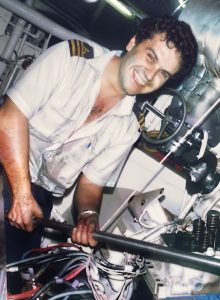
At 19 he joined the merchant marine for a prolonged career that took him to all corners of the globe, first as a trainee then as a chief engineer. “Basically I’ve sailed on anything that floats, container ships and passenger ships.”
But his preference for recreational boats meant fate steered him towards the yachting industry.
“It was 1998, the year the Recreational Craft Directive (RCD) was implemented,” he recalls of the career turning point96. “I was at a boat show in Amsterdam, and there was a stand looking for surveyors in inspectors”
“I took a flyer and sent in my CV, more out of curiosity – I wasn’t really looking for a job.”
“The next day they called me. They said you can start tomorrow.”
Thus began a decades-long association with the Brussels-based International Marine Certification Institute (IMCI), and a new career trajectory that, ultimately, explains why Peter is drinking a Rooibos cappuccino inside a Cape Town coffee shop, not koffie in Amsterdam.
Peter was soon well acquainted with the RCD, but evidently many boat builders were not, including South Africa’s then nascent sector. In 1998 Jacops met Jerry Caine from Robertson and Caine at METS, in what would be another career turning point. “We had an ECB stand at METS, and he (Jerry) came to us and asked if we could send somebody to Cape Town ASAP.”
“Probably because of my travelling experience, they decided to send me.”
He couldn’t believe his luck. Cape Town so agreed with him that two years later, when IMCI announced they needed a permanent presence in the Mother City, he jumped at the opportunity.
These were boom years for South African boatbuilding, with exporters literally queuing for certification services at the Cape Town boat show.
They were also halcyon days for Peter and wife Nicole (also a keen sailor and merchant mariner daughter) who lived happily on their 42 ft yacht at the Hout Bay marina – it had been shipped out from Europe. “It was a very nice part of my life – I loved living in the marina,” he says, noting that marina liveaboards are now a thing of the past. “I really don’t know why they changed the rules – it is a way of life,” he says wistfully.
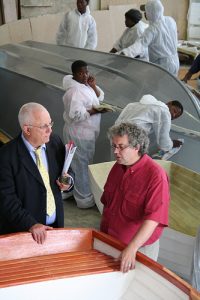
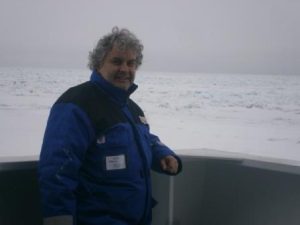
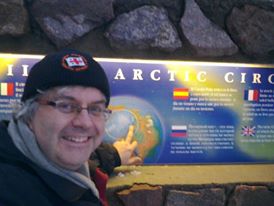
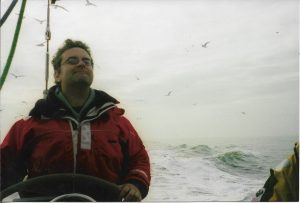
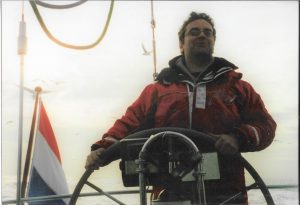
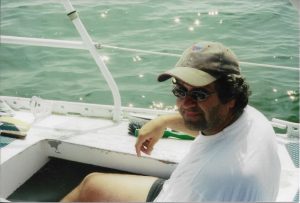
Despite his professional attachment to rules, Peter appears happiest making up his own, judging by the scrapbook view of his life. Photos of him as a young man show him beaming in the breeze, gazing out to sea. But even in the engine room he is smiling, or meeting with boating stakeholders to discuss their latest build.
The overarching motif is Peter the sea gypsy, squeezed into the tight-fitting mould of a landlubber, an impression amplified by his rebellious hair, now white and streaking down his chin in a jaunty goatee.
Little wonder he prefers Cape Town to Antwerp.
But If the soft landing in the Cape seemed too good to be true, the 2008 credit crunch proved was a brutal reality check, with a precipitous decline in the boat export market. Suddenly survey requests were few and far between, with Peter now supporting a growing family – his daughter was born in 2010.
Nicole, a yacht broker, was similarly hard hit by the economic downturn.
“It was so rare just to have a survey in those days,” he recalls, “but we needed to put bread on the table.”
And so they relocated again, this time to Thailand, where he worked briefly as a production manager in a South African-owned boatyard. When the company folded, Peter set up his own business, travelling back to Cape Town whenever work allowed.
“At the time, there was not enough work to come back [permanently],” so they stuck it out in Thailand for a few more years. Then, just as they were finally ready to return, Covid scuppered their plans as the world went into lockdown.
“We were back to square one.”
Then came the post-Covid boating boom, and the compass pointed south once more. Certification work skyrocketed, particularly in Cape Town with a fleet of new yards and models.
He recalls a car rally through southern Africa that proved something of a turning point. “I realised, this is where I want to be. I asked Nicole, what are we actually doing here in Thailand, I don’t really like it.”
Two months later they were on the plane back to Cape Town.
Forward wind a couple years and life has slowed down for Peter, who still travels but not as enthusiastically as before. I imagine him once nursing hangovers in the same way that he now nurtures his rooibos cappuccino, pacing himself as his story mellows with age.
“I just want to stay here – I love it here.” His gaze drifts happily across a sunny coffeeshop half-filled with digital millennials. The wanderlust that once propelled him across oceans, now rocks us gently to and fro, a new journey of thoughts and conversation, still hitched to maritime but keen to explore new frontiers.
Peter’s life has got simpler, but his work hasn’t. New regulations and new technologies add to the checklists required of marine certification, even as AI removes some of the administrative burden. “It is now a lot more complex to go through the certification process than it was 15 years ago. Boats are so much more complex – some of them are like floating condos.”
“It is not anymore little 12 volt lights – it has become very complex, with every month a new battery system, and one has to keep updated with the latest tech and materials.”
The mix of different materials and techniques makes assessment more difficult, and calculations more onerous. Whereas boats used to be mostly a uniform construction, now different compartments require different checklists.
The move to faster and lighter performance boats also means finer margins of error. “This makes it more dangerous for us to certify because they are playing right at the limits, and any change could have disastrous consequences. In some ways I would prefer (to certify) a boat of twenty years ago.”
The certification process has evolved, too, now involving multiple inspectors. “I first have to scrutinise the file with the boat – to confirm that they are building what they say they are building – and after the necessary changes I then submit to head office, where three or four guys will go through everything and come back with questions.”
“Public scrutiny has become a lot harsher, and notified bodies are just a lot more cautious.”
By comparison my Peter Jacops assessment has been largely superficial, drawing to a close after just one cappuccino. Clearly, there is structural integrity; solid propulsion and communications; and clever use of materials. Plenty seawater in his soul.
Just enough twinkle in his smile.
Hairstyle compliance could use some work if he ever leaves Cape Town. Hopefully he doesn’t.