
Many people fantasize about buying their dream yacht for their twilight years.
Michaell Vijverberg on the other hand, prefers reconstructing his dream yacht one plank at a time.
He also isn’t waiting for retirement; he has a team of artisans working full-time on his latest boat project at the back of the Hout Bay Yacht Club. There you will see the 60ft schooner Comus of Wivenhoe, a gaff schooner built in 1882 as a racer/cruiser, now being faithfully restored. If all goes according to plan she will be ready to launch in a little over two years’ time.
“Very few people take the leap,” Vijverberg says of the rare pleasure of classic yacht restoration. “I don’t feel there’s a lot of interest here – people tend to look at the downside.”
He sees the upside.
A sailing enthusiast since his childhood in the Netherlands, Vijverberg took an early interest in offshore racing and inland dinghy sailing. His passion continued into adulthood as he made his way into the business world, traveling around the world for a large chemical supply company. He lived in the US, Canada and South America, before moving back to Holland where he acquired his first classic boat – a 40ft Danish cutter.
He then moved to South Africa where he now lives with his wife and four children.
Initially based in Johannesburg – he moved to the Cape five years ago – Vijverberg scratched his sailing itch mainly in the waters around Madagascar where he kept a charter catamaran. He later bought two Knysna catamarans (44ft and 48ft) for the charter market in the Maldives.
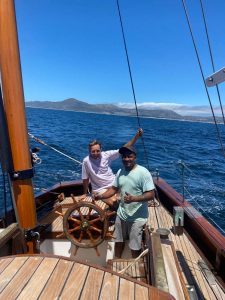 His passion for classic boats is evident when talking about his current project, Comus of Wivenhoe, as well as his previous restoration project, Elegance, a 1932 gaff ketch (44ft) now berthed at HBYC marina. By his own admission he now spends more time on the restoration project than at work, although he is quick to credit his boatbuilding team as the real stars of the show. The team is led by long-time Hout Bay boatbuilder Lorenzo Smith, who has a lifelong background in wooden fishing vessel repair. “He has really proven himself,” says Vijverberg. “There are some very good people right here in Hout Bay.”
Remarkably, Comus has largely withstood the vagaries of time such that the restoration team are using some of the original cast iron ballast blocks and rib bases as well as the original keel. The wooden ribs (frames) are being replaced one by one while keeping the old planks in place. Once the ribs have been reconstructed, the planks will be replaced. The deck beams and clamp shelves, which were partly replaced in earlier repairs, are still 100%.
As much as possible, Vijverberg is determined to stay faithful to the yacht’s original look and feel. “Of course one can’t do that 100%, but it is amazing how the boat has survived so well.”
Both of his classic boats have a storied past, with Comus in particular serving as a reminder of human ingenuity – it predates the Boer War but, once restored, could still cross the oceans.
Says Vijverberg: “It would be unforgivable if we would allow history that has been kept in these boats to just disappear. At the same time, wooden fishing vessels are continuously replaced by steel and fibreglass vessels and will probably not be commercially used in another 10-20 years. We run the risk that the skills to build and repair wooden boats will just disappear. Restoration of classic vessels and sailing yachts will allow the next generation of Hout Bay shipwrights to play a role in maintaining the beauty of history.”